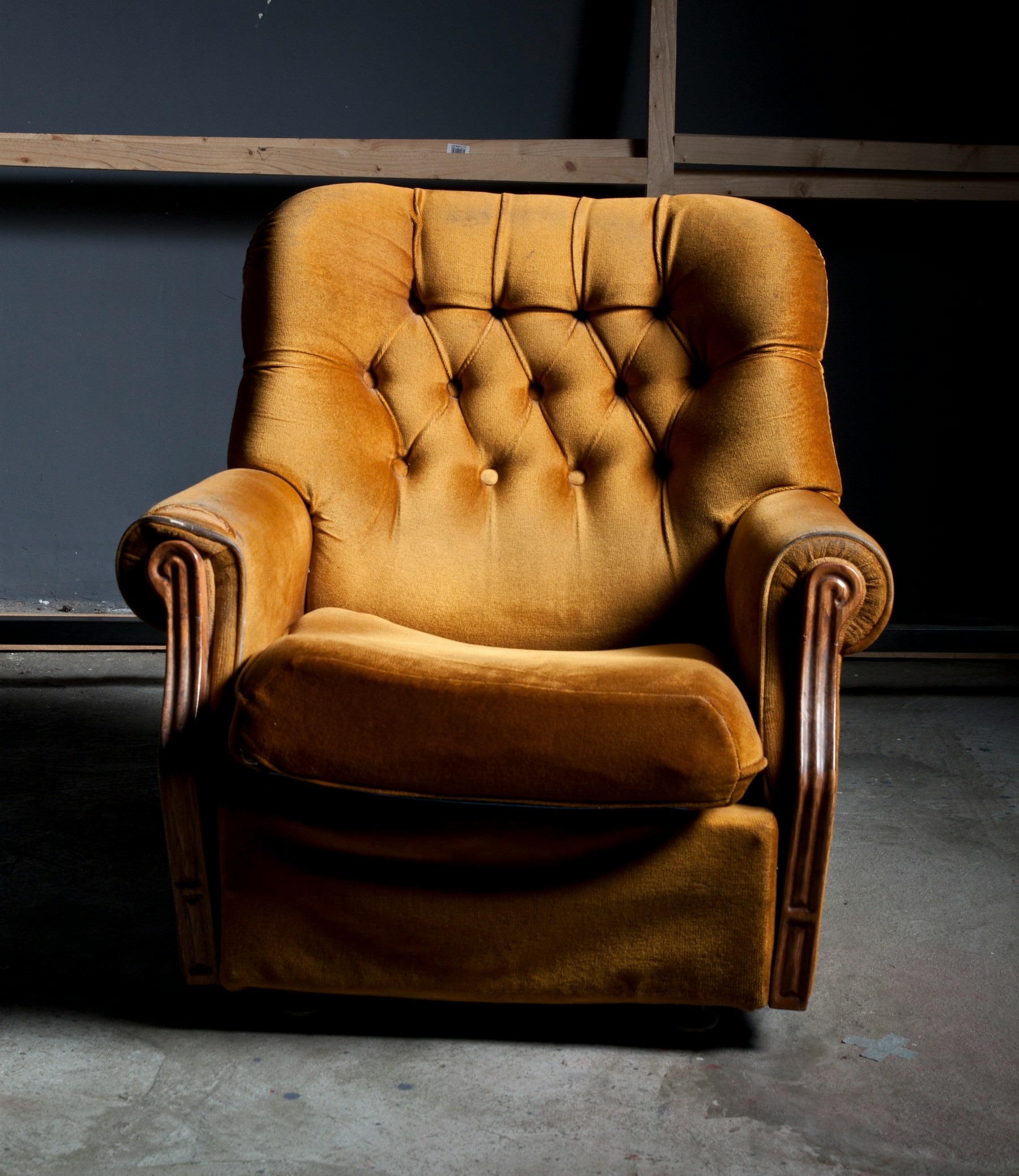
You have a chair. It is comfortable, the fabric is finished, and somebody has told you it would be cheaper to buy a new one. Whether that is true depends almost entirely on how the frame under the fabric was built, and that is a thing you can check yourself in about a minute.
What a redo actually costs
A standard armchair runs $480 to $760 in labor, plus fabric. Fabric is the part people underestimate: a wing chair takes about seven yards, a club chair six, a three cushion sofa needs fourteen to eighteen. At $30 a yard that is $210 on the chair and closer to $500 on the sofa, and there is nothing to be done about the yardage except pick a fabric without a repeat.
So a chair lands somewhere near $700 finished and a sofa somewhere past $1,400. A new sofa at that price is particleboard, stapled, with a foam core that will be flat in four years. A sofa built in 1968 that is worth reupholstering has a kiln dried hardwood frame, doweled and corner blocked, and eight way hand tied springs underneath. That frame will outlive whoever pays for the new fabric.
The one minute test, before you ring anybody
- Lift one front corner six inches off the floor. If the other front leg comes up with it, the frame is rigid and it is worth doing. If the piece twists, the joints are gone.
- Push down hard in the middle of the seat. Springs that push back evenly are coil. A soft even sag with no sound is a webbing or foam deck, which is fine but cheaper to replace than to keep.
- Look underneath. Staples into plywood and stapled cardboard corners mean it was built to be thrown away. Dowels, screws, glue blocks and burlap mean it was not.
- Smell it, honestly. Smoke comes out. Cat urine in the deck usually does not, and that is the one thing that ends the conversation.
If it fails all four, the answer here is that you should buy a new chair, and that gets said out loud rather than quoted around.
Work, before and after
These are the frames to photograph as they come through the shop. Each pair is one piece, shot from the same spot on the same day it came in and the day it went out, because that is the only comparison worth anything.
Pair one, a wing chair
Before
The wing chair as delivered, three quarter view from the left, on the shop floor in daylight. Worn arms and split welting in frame. No people, no props.
After
The same chair, same spot, same angle, same light, finished. Nothing moved between the two shots but the chair.
Seven yards, new foam in the seat, springs retied. About $690 plus fabric. Two and a half weeks in the shop.
Pair two, a dining set
Before
Six dining chairs lined up against the wall, seats out, showing the split vinyl and the old tacks. Straight on, wide enough to get all six.
After
The same six in the same line, recovered, seats back on. Close crop on one corner as a second frame if there is room.
Drop in seats, half a yard each. $55 a chair plus fabric, and they go out the same week they come in.
Pair three, a truck bench
Before
A pickup bench seat out of the cab, on sawhorses, split along the seam with the foam showing. Shot from above at an angle.
After
The finished bench on the same sawhorses in the same light, with the original grain vinyl matched.
Marine vinyl, new foam, original seam pattern copied. $340 to $520 depending on whether the springs are salvageable.
How to start
Send two photographs and one measurement. The photographs are the whole piece from the front and the underside with the piece tipped over, and the measurement is the width across the front at its widest. That is enough for a real number, not a range, in a day.
Or ring (816) 555-0125 and describe it. The shop is a one room operation and the phone gets answered by the person who will do the work, which means the estimate you get on the phone is the estimate. Fabric is chosen here from books, or you can bring your own yardage and that is genuinely fine.
Turnaround runs two to five weeks depending on what is already on the floor, and that number is said before anything is taken apart, never after. Deposit is half, the balance on collection, and nothing gets stripped until the fabric is in the building.
Not done here
- Boat and pontoon interiors
- Automotive headliners and convertible tops
- Slipcovers, which are a different trade and done better elsewhere
- Leather refinishing and dyeing, though leather can be replaced
- Anything with active mould, or a deck that has been urinated in